


BY SIFISO NHLABATSI
EZULWINI – The World Bank has urged Eswatini to invest smarter in agriculture.
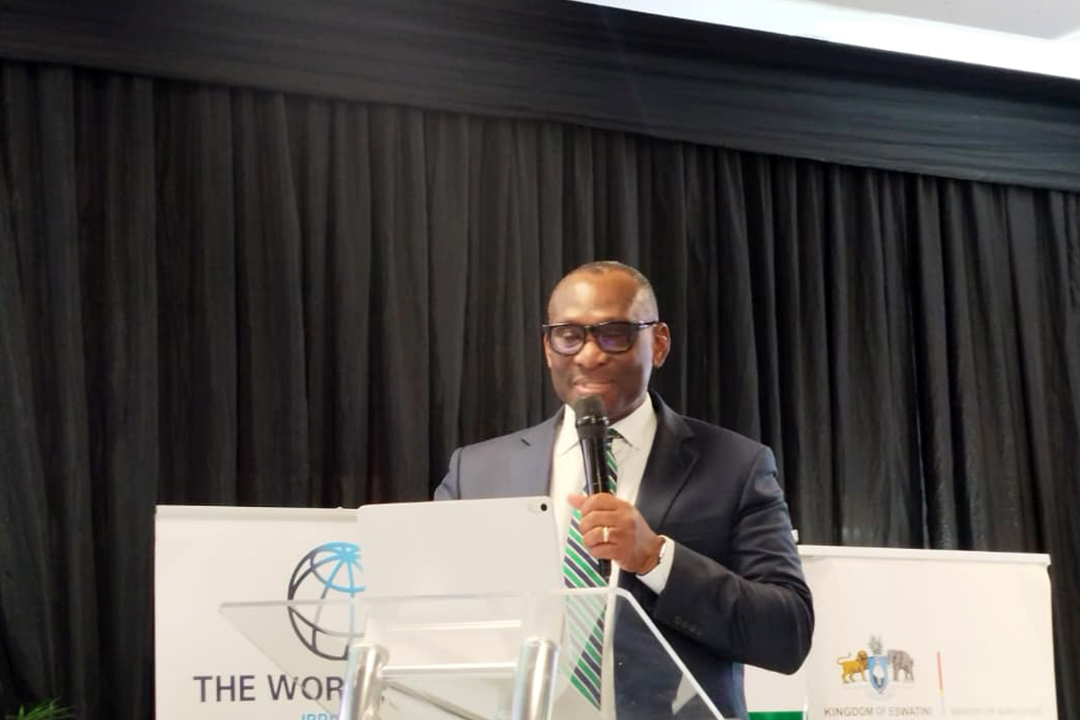
The call came during the National Strategic Dialogue on Transforming Agriculture and Agribusiness in Eswatini held at Happy Valley Hotel, where World Bank Country Manager Ikechi B. Okorie said increased public spending alone would not transform the sector unless it was strategically used to attract private investment, reduce risks and build stronger agricultural systems.
Okorie revealed that public expenditure on agriculture increased by 113 per cent in real terms from E896 million in 2010 to E2.86 billion in 2021, yet warned that spending by itself could not deliver the transformation required to unlock the sector’s full potential.
He said government should focus on creating an environment that enables the private sector to invest rather than attempting to do everything on its own.

“When public expenditure substitutes rather than catalyses private investment, not only does the sector stagnate but the risks are borne by taxpayers and the outcomes are often limited,” he said.
Instead, he said, public investment should reduce risks by strengthening institutions, expanding infrastructure, improving information systems and creating a regulatory environment that encourages investment at scale.
“This is not advocating for a retreat of the state but rather a smarter role for it, investing where only government can and creating space for markets to act,” he said.
Okorie explained that the Agriculture Sector Review was commissioned after the World Bank presented its Country Economic Memorandum to the newly elected government in January 2024.
The report, titled In Search of the Drivers of Inclusive Growth, identified agriculture and agribusiness, alongside eco-tourism and digital financial services, as sectors with the greatest potential to create employment, increase exports and accelerate Eswatini’s journey towards high-income status.
He said the Agriculture Sector Review was therefore undertaken to provide an in-depth assessment of how the country could unlock opportunities in agriculture.
According to Okorie, the review sends three key messages.
Firstly, agricultural investment should adopt a holistic approach involving government, the private sector and financial institutions.
Secondly, policymakers should rethink the relationship between the state, markets and smallholder farmers by recognising that food systems are also economic systems capable of generating wealth.
Thirdly, public spending should be used to unlock rather than replace private capital.
He said the transformation of agriculture depended on creating commercially viable value chains that connect smallholder farmers to markets, finance, technology and infrastructure.
Drawing from the World Bank’s AgriConnect initiative, Okorie said the biggest challenge facing farmers was not the availability of land or willingness to work but the absence of systems that link them to economic opportunities.
He said many farmers lacked reliable markets, suitable financial products, aggregation systems, extension services, digital technologies and efficient transport infrastructure.
“AgriConnect is about deliberately building those missing links so that smallholders move from subsistence to surplus production and eventually to commercial farming within profitable value chains,” he said.
He added that countries which successfully connected farmers to viable markets experienced higher rural incomes, increased food security and stronger economic growth, particularly benefiting women and young people.
Okorie said the Solutions Marketplace launched alongside the dialogue demonstrated that many of the answers already existed within Eswatini.
He described the marketplace as a platform showcasing innovations that are already delivering results and which can now be replicated and supported through partnerships, finance and enabling policies.
“The solutions are already among us. Let us connect them to partners, finance and policy support so they can grow,” he said.
Supporting the World Bank’s position, Minister of Finance Neal Rijkenberg said government shared the view that public resources should generate measurable results.
Addressing delegates, Rijkenberg said the Solutions Marketplace was positioning Eswatini’s agriculture as a competitive, resilient and investment-ready sector capable of driving sustainable economic development.
He said the initiative brought together government, financial institutions, researchers, farmers, development partners and the private sector to identify innovations capable of transforming agriculture.
“The Solutions Marketplace is not merely a competition but an investment in Eswatini’s future,” he said.
Rijkenberg said every innovation presented during the exhibition had the potential to increase productivity, reduce production costs, improve efficiency, create employment and expand economic opportunities.
He stressed that government had a responsibility to ensure every public investment produced measurable impact.
“Innovative and scalable solutions improve the efficiency and effectiveness of public programmes while technology and digital tools maximise returns on agricultural investments,” he said.
The finance minister also acknowledged the World Bank’s continued support, saying the partnership enabled Eswatini to benefit from global expertise while strengthening locally developed innovations.
He noted that digital agriculture was becoming increasingly important in improving food security, expanding market access and increasing the competitiveness of local farmers.
Rijkenberg further said climate change continued to pose significant fiscal and economic risks, making investment in climate-smart agriculture essential to protect livelihoods while safeguarding public resources.
He reaffirmed government’s commitment to supporting initiatives that promote innovation, strengthen economic resilience, improve agricultural competitiveness and generate inclusive economic growth.
The minister encouraged innovators across the country to use the Solutions Marketplace to present their technologies and ideas to government, investors, development partners and financial institutions, saying the platform highlighted Eswatini’s ingenuity and its capacity to drive national development through agriculture.
#WorldBank #AgricultureSectorReview #SmartInvestment #AgricultureEswatini #Agribusiness #SolutionsMarketplace #ClimateSmartAgriculture #FoodSecurity #DigitalAgriculture #EconomicGrowth #PrivateSector #Innovation #EswatiniPositiveNews
(Courtesy Pic)