


BY THEMBA ZWANE
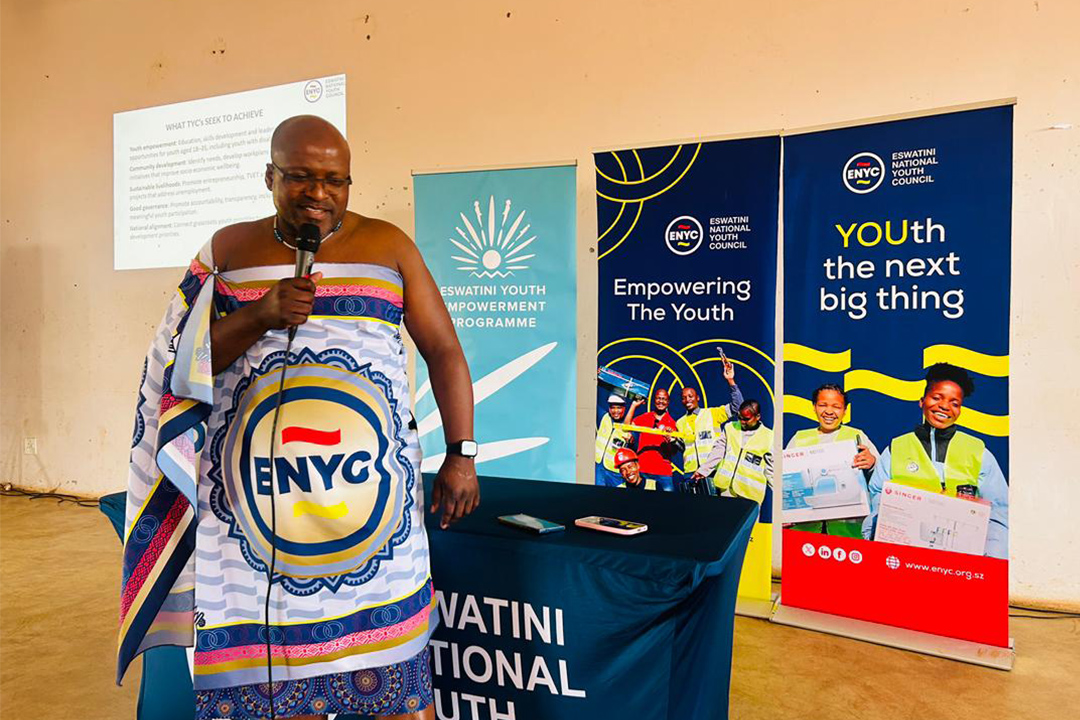
NHLANGANO– Government has begun strengthening youth development at grassroots level by rolling out specialised training for Tinkhundla Youth Committees, with the Shiselweni Region becoming the starting point of the programme.
The initiative, led through the Eswatini National Youth Council (EYNC) under the Ministry of Sports, Culture and Youth Affairs, is aimed at equipping youth committee members with the skills needed to effectively represent young people in their communities and connect them with government programmes and opportunities.
The Minister of Sports, Culture and Youth Affairs, Bongani Nzima, said the programme represented an important investment in the country’s youth development coordination system.
His remarks were delivered on his behalf by Ministry Under Secretary Mzwandile Mthethwa during the official opening of the Tinkhundla Youth Committees training at REO Hall in Nhlangano on Wednesday.

Minister Nzima commended the EYNC for taking the capacity-building programme directly to the regions, saying meaningful youth development must begin where young people live, interact, pursue opportunities and experience challenges.
“This programme is therefore much more than a training exercise. It is an important investment in strengthening the machinery through which the voices, aspirations and experiences of young people can contribute to our country’s development,” he said.
The initiative is significant because it seeks to strengthen the link between communities and the national youth development system.
Government, through the EYNC, is implementing the National Youth Development Coordination Framework, which is designed to strengthen the coordination, planning, implementation, monitoring and reporting of youth development interventions across the country.
The Minister stressed that the framework recognises that youth development cannot be left to one institution alone, requiring collaboration between Government, development partners, civil society, the private sector, youth-led organisations and young people themselves.
However, he said the success of national youth development programmes would ultimately depend on what happens at community level.
“We cannot build an effective national youth development system if the structures closest to young people are not adequately equipped, supported and empowered to perform their responsibilities,” he said.
59 TINKHUNDLA AT THE CENTRE
The Tinkhundla Youth Committees are strategically positioned to provide a link between young people and the wider youth development coordination system.
With committees operating across the country’s 59 Tinkhundla, their responsibilities include listening to young people, identifying their priorities and emerging challenges, mobilising them to participate in programmes and ensuring that information about opportunities reaches communities.
Minister Nzima described the committees as the “eyes and ears” of the youth development system at community level.
He said the quality of information reaching regional and national structures would depend largely on the committees’ ability to listen, document, report and accurately represent the realities of young people.
The training is also exposing committee members to programmes including YouthConnekt and the Eswatini Youth Empowerment Programme.
These programmes are intended to connect young people with opportunities, skills, networks and support that can contribute to their personal development and economic empowerment.
The Minister, however, noted that programmes could only make a difference if young people knew about them and could access them.
He therefore challenged the committees to ensure that information about available opportunities reaches communities while also bringing feedback from young people back into the system.
“If a programme is working, we need to know why it is working. If young people are facing barriers, we need to understand those barriers. If there are gaps in our interventions, we need to hear about them,” he said.
FROM TRAINING TO ACTION
The training covers five key areas – governance, safeguarding, community mobilisation, reporting, and monitoring and evaluation.
According to the Minister, these areas will equip committee members with a common understanding of their mandates, leadership responsibilities, accountability, ethics, decision-making and operational procedures.
The training will also strengthen their ability to mobilise young people, document community issues and provide information that can be used to assess whether youth interventions are achieving their intended results.
Minister Nzima said the establishment of youth committees alone was not enough.
“A structure is only as effective as the people who understand its mandate and have the knowledge, skills and commitment to carry out its responsibilities,” he said.
He urged committee members to view their role as a responsibility to represent young people rather than simply attend meetings.
He challenged them to listen to young people, understand their realities, identify challenges and opportunities, and ensure that emerging issues are properly documented and communicated through the appropriate structures.
“Report accurately. Listen carefully. Represent responsibly,” he said.
YOUTH VOICES TO REACH NATIONAL LEVEL
Government’s approach seeks to create a clearer pathway for youth concerns from communities to regional and national decision-making structures.
The Minister said meaningful youth participation should go beyond inviting young people to meetings and events.
Instead, it should create structures through which young people can express their priorities, contribute ideas and influence decisions and development processes affecting their lives.
He said the Tinkhundla Youth Committees provided an important platform for achieving this at grassroots level.
He also called on the committees to ensure that young people who might otherwise struggle to access programmes and opportunities were not left behind.
“Our communities are diverse, and young people have different circumstances, needs and experiences. We must therefore be deliberate in ensuring that those who may otherwise struggle to access programmes and opportunities are not forgotten,” he said.
SHISELWENI AS PILOT REGION
The rollout began in Shiselweni, with the Minister describing participants as pioneers in the process.
The regional approach is intended not only to take training closer to committee members but also to create an opportunity for participants from different communities to share experiences, identify common challenges and exchange practical solutions.
Government also expects lessons and recommendations emerging from the Shiselweni training to help inform the rollout of the programme in the other regions.
Minister Nzima said the ultimate measure of success would not be the number of people attending the training, but what happens after they return to their communities.
“We want to see better-functioning Tinkhundla Youth Committees. We want to see stronger mobilisation of young people. We want to see community-level information informing decisions at regional and national level,” he said.
He added that the ultimate goal was for young people to experience the difference that stronger coordination could make in their communities.
The Minister officially declared the Regional Tinkhundla Youth Committees Training Programme open, urging participants to turn the knowledge gained into action.
Government’s vision, he said, was not simply to have youth structures in place, but to establish functional, accountable and responsive youth structures capable of contributing meaningfully to national development.
#Eswatini #YouthDevelopment #TinkhundlaYouthCommittees #Government #YouthEmpowerment #Shiselweni #NationalYouthDevelopment #YouthParticipation #YouthConnekt #EswatiniYouthEmpowerment
(Courtesy Pic)