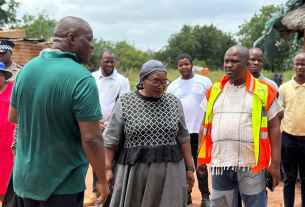




BY THEMBA ZWANE
MBABANE– Eswatini’s struggle to adapt to a changing climate has attracted fresh international attention, with foreign environmental publication Resilience spotlighting a remarkable grassroots effort taking shape in the mountains around Sibebe Rock.
In a feature published on September 4, 2026, journalist Thomas Shivers takes readers into the mountains of north-western Eswatini, where a local gardener and conservationist identified as Warren is using indigenous plants, permaculture, recycling and community conservation to respond to increasingly unpredictable weather.
The article, titled “A garden paradise in the clouds: A story of climate adaptation in Eswatini,” portrays Warren’s 35-hectare mountain property as more than a garden. It is emerging as a practical demonstration of how local knowledge and environmentally friendly practices can help communities confront the effects of climate change.
Warren, now in his seventies, has cultivated a rich garden of subtropical and indigenous plants on the mountainside near Sibebe Rock. According to the report, he has deliberately focused on plants native to the area, while working with neighbouring landowners who share his interest in conservation.

His vision extends beyond his own property. Warren and fellow conservation-minded neighbours hope to transform surrounding land into a nature reserve capable of protecting endangered indigenous species.
But the idyllic mountain environment is increasingly being tested by changing weather patterns.
The foreign journalist records Warren’s observation that rainfall has become more unpredictable, arriving later and with greater intensity. The heavier rains have contributed to saturated soils, crop problems, erosion, damaged roads and overflowing rivers.
The report notes that the Highveld areas around Sibebe receive substantially more rainfall than Eswatini’s eastern lowlands, with annual mean rainfall around 1,500 millimetres in the Highveld. Climate research cited in the article indicates that the region is expected to experience increasingly unsettled weather and more frequent heavy rainfall events.
For rural communities, the consequences can be severe.
The article highlights the country’s dependence on subsistence agriculture and warns that waterlogged soils can increase crop vulnerability to disease and failure. Heavy rainfall also threatens roads and other infrastructure, potentially restricting access to schools, hospitals and other essential services.
Warren has personally experienced the effects.
The report says rivers have burst their banks near his property, while heavy rainfall has worsened erosion along mountain roads and tracks. Following a prolonged spell of rain, he personally helped rebuild damaged paths and worked on a road leading towards Sibebe Resort so that children could continue travelling to school.
But his response to climate change is not limited to repairing damage.
TURNING INDIGENOUS KNOWLEDGE INTO ADAPTATION
One of the most interesting aspects of the foreign report is Warren’s emphasis on indigenous vegetation.
He collects indigenous plants and topsoil from his land and propagates them around his property. The plants, according to his observations, are generally better suited to the local environment and can help restore degraded land, protect soil against erosion and support biodiversity.
The approach has also brought Warren into conflict with one of the area’s growing environmental problems – invasive Australian wattle.
The report says wattle has spread extensively across the hills, competing with indigenous vegetation and consuming groundwater. Warren and his neighbours have responded by cutting back the invasive trees while using the resulting wood as fuel and building material.
Their strategy illustrates a broader climate challenge: adapting to changing weather while simultaneously protecting ecosystems that are already under pressure.
RECYCLING WASTE INTO CLIMATE SOLUTIONS
Perhaps the most striking element of Warren’s approach is his belief that some of the solutions are already available within communities.
He advocates reusing household and agricultural waste rather than burning it or allowing it to accumulate.
The report describes how old materials can be repurposed for agricultural and household uses. Warren, for example, has reused an old washing-machine drum as a fire pit, while soft plastics can be converted into sacks for growing tree seedlings.
Food and agricultural waste can also be transformed into compost, providing farmers with an affordable source of nutrients while reducing dependence on externally sourced fertilisers.
The foreign report further highlights the possibility of using organic waste and worm composting to produce fertiliser that can be sold locally.
For Warren, these are not simply environmental ideas. They are potential tools for helping communities become more resilient while creating small economic opportunities.
A CHANGING CLIMATE, A CHANGING COMMUNITY
The article also points to a significant challenge: climate adaptation depends not only on technology and infrastructure, but on people’s awareness and willingness to change practices.
It cites research indicating that a significant proportion of rural Emaswati remain unaware of climate change, while many who are aware of it report already having to adjust their lives because of changing weather patterns.
Warren believes change can begin with individuals and spread through communities.
His philosophy is simple: one person can demonstrate a different way of doing things, encouraging others to follow.
That belief is at the heart of the foreign journalist’s account.
The story is not about a major government programme or an international climate conference. Instead, it presents one rural Emaswati and his neighbours as examples of how communities can begin adapting to environmental changes from the ground up.
And in the misty mountains around Sibebe Rock, that adaptation is taking the form of indigenous gardens, restored paths, compost, recycled materials and efforts to protect native ecosystems.
The foreign spotlight therefore presents another side of Eswatini’s climate story – one in which resilience is not only being discussed in policy documents, but is being practised at household and community level.
As Warren continues nurturing his mountain garden and pursuing his vision of a nature reserve, the experiment around Sibebe offers a powerful reminder that climate adaptation can begin with something as simple as what communities choose to plant, preserve, reuse and pass on.
#Eswatini #Sibebe #ClimateChange #Adaptation #CommuniyLevel #MountainGarden
(Courtesy Pic)