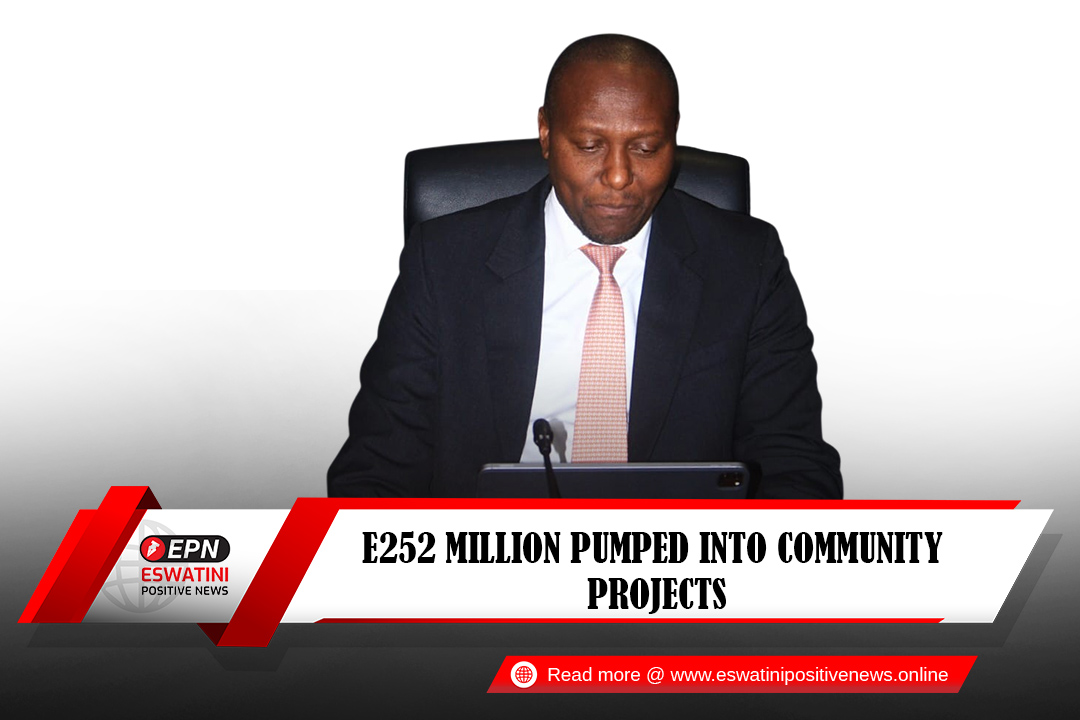



…RDF records impressive 92% performance
…133 young EmaSwati share E4.5 million in business loans
…Govt annual performance improves from 22% to 48%
BY MBONGENI NDLELA
MBABANE– More than E252 million has been channelled into community development projects across Eswatini, emerging as one of the strongest delivery highlights in Government’s 2025/26 Annual Performance Report released by Prime Minister Russell Mmiso Dlamini today.
The massive investment through the Regional Development Fund (RDF) represents money being taken directly to communities for projects designed to improve livelihoods, strengthen local economies and address development needs at grassroots level.
According to the report, the RDF achieved an impressive 92% performance score, with E252 770 052.14 disbursed towards community projects during the financial year.
The figure stands out in a Government Performance Report which shows that the administration progressively improved its overall performance from 22% in the first quarter to 48% by the end of the financial year.

For ordinary EmaSwati, however, some of the clearest evidence of government implementation is contained in interventions that have put resources directly into communities and into the hands of aspiring young entrepreneurs.
Alongside the E252.7 million channelled through the RDF, 133 young people from all four regions of Eswatini received business loans totalling E4501293.40 through the Youth Fund.
This translates to more than E4.5 million being directed towards youth entrepreneurship as Government seeks to move young people from being job seekers towards becoming business owners and employment creators.
The two interventions, community project financing and youth enterprise support, provide a human face to the performance statistics contained in the report.
While government departments are assessed through percentages, targets and outputs, the RDF and Youth Fund figures demonstrate how some of those targets ultimately translate into money reaching communities, entrepreneurs and development projects.
RDF among government’s strongest performers
At 92%, the Regional Development Fund intervention performed significantly above Government’s overall annual average of 48%.
Under the Government scoring system, performance between 80% and 99% is classified as “good progress”, placing the RDF firmly among the strongest-performing interventions recorded during the period.
The fund is designed to finance community-driven development initiatives and give communities an opportunity to participate directly in economic and social development.
The E252.7 million disbursement therefore represents one of the clearest examples in the report of public resources being converted into grassroots development interventions.
It also comes at a time when Government is placing increased emphasis on inclusive economic growth, rural development and ensuring that national development reaches communities beyond major urban centres.
Youth get E4.5 million business boost
Young entrepreneurs were another significant beneficiary of Government interventions during the year.
The annual report states that 133 young people across Eswatini’s four regions received E4501293.40 in business loans.
The Youth Fund intervention was assessed at 42%, indicating that while substantial funding reached beneficiaries, there remains considerable room to widen access and accelerate implementation.
For the beneficiaries, however, the loans represent an opportunity to establish enterprises, grow existing businesses and create income in an economy where youth employment remains one of the country’s major development priorities.
Government also reported that 2576 young people received pre-entrepreneurship training and mentorship during the period.
This was complemented by training for 222 artists, who were equipped with business skills, financial literacy and knowledge of legal requirements to assist them in transitioning into the formal economy.
Taken together, the initiatives show a broader attempt to combine financing with business development skills rather than relying exclusively on the provision of capital.
Community delivery part of bigger performance turnaround
The community development achievements were recorded during a year in which overall government performance followed a steady upward trajectory.
Government began the financial year with a performance score of just 22% in the first quarter.
That increased to 31% in the second quarter, rose further to 41% in the third quarter and eventually reached an annual score of 48%.
The report attributes the improvement to corrective measures and institutional learning during the year.
However, it also acknowledges that the final result remained below the 50% threshold, meaning that more than half of planned outputs had not been fully achieved.
Among the challenges identified were delayed budget releases, slow procurement processes and weaknesses in planning.
Government has consequently identified the need to begin major activities earlier in the financial year, strengthen quarterly monitoring and intervene sooner where ministries begin falling behind their targets.
Social protection, food security lead national priorities
The performance report also assessed Government according to six broad Programme of Action objectives.
Social Protection and Security emerged as the best-performing objective at 56%, followed closely by Food Sovereignty and Sustainable Development at 55%.
Economic Growth recorded 50%, while Infrastructure and ICT Integration stood at 48%.
National Security and Law Enforcement achieved 43%, while Human Capital, encompassing important health and education interventions, recorded the lowest performance at 37%.
The strong showing in social protection and food sovereignty complements the development taking place through community-based funding, as Government seeks to ensure that economic transformation also reaches households and vulnerable communities.
Business reforms also deliver results
The report records several other major achievements during the financial year.
The National One-Stop Business Centre achieved a 100% performance score, with the time required for business registration reduced to three days.
The One-Stop Border Management programme also achieved 100%, while the State Business Relations Secretariat scored 86%.
Construction of the Biotechnology Centre reached 80%, while a Technology and Innovation Support Centre at the University of Eswatini was assessed at 100%.
Government also reported progress in financial modernisation, including the upgrading of the Financial Intelligence System, which achieved 100%, and development of the Integrated Financial Management Information System.
The Grand Plan, expected to provide a broader framework for national transformation, stood at 70%, with a draft already developed and its socialisation continuing.
Correctional services tops ministries and departments
Across ministries and departments, His Majesty’s Correctional Services emerged as the highest-performing institution at 75%.
It was followed by the Ministry of Sports, Culture and Youth Affairs at 60%, the Ministry of Health at 58% and the Prime Minister’s Office at 56%.
The report nevertheless notes that performance varied substantially between institutions, with several ministries remaining below the national average.
This uneven performance is one of the key areas Government will have to address if the positive movement recorded between the first and final quarters is to translate into stronger overall delivery.
From percentages to people
Perhaps the most important story emerging from the Annual Performance Report is not contained only in the percentages.
It is also in the E252.7 million that reached community projects, the E4.5 million extended to 133 young entrepreneurs, the thousands receiving entrepreneurship training and the reforms intended to make it easier to establish and operate businesses.
These are interventions with the potential to translate government policy into economic activity at household and community level.
For Prime Minister Russell Mmiso Dlamini’s administration, the 2025/26 results therefore present both an encouraging trajectory and a clear challenge.
Government has demonstrated an ability to move its overall performance from 22% to 48% within the financial year, while several individual programmes achieved substantially stronger results.
The next task is to ensure that these pockets of high performance become the standard across Government.
And for communities benefiting from the more than E252 million already disbursed through the Regional Development Fund, the impact of Government performance is increasingly being measured not only through reports and percentages — but through projects taking shape on the ground.