


BY SIFISO NHLABATSI
MBABANE – Government says progress recorded under its Economic Growth objective places Eswatini on a path towards achieving its ambitious target of attaining 12 per cent GDP growth by 2029.
This target is the cornerstone of the Eswatini Government Programme of Action (2024–2029) under the national “Nkwe” mandate. Essentially, the country wants to more than double the speed at which its economy expands, moving from its recent growth rate of around 4% to 5% up to a double-digit 12%.
The government does however acknowledges that faster implementation and stronger economic reforms will be required to reach the target.
The 2025/26 Government Performance Report shows that the Economic Growth objective achieved an overall performance score of 50 per cent, making it the third-best performing of the six objectives under the Nkwe Programme of Action. The objective covers areas including trade facilitation, improvements to the business environment and support for micro, small and medium enterprises (MSMEs).
The performance comes as Government recorded an overall annual performance score of 48 per cent, a significant improvement from the 22 per cent recorded during the first quarter of the 2025/26 financial year.

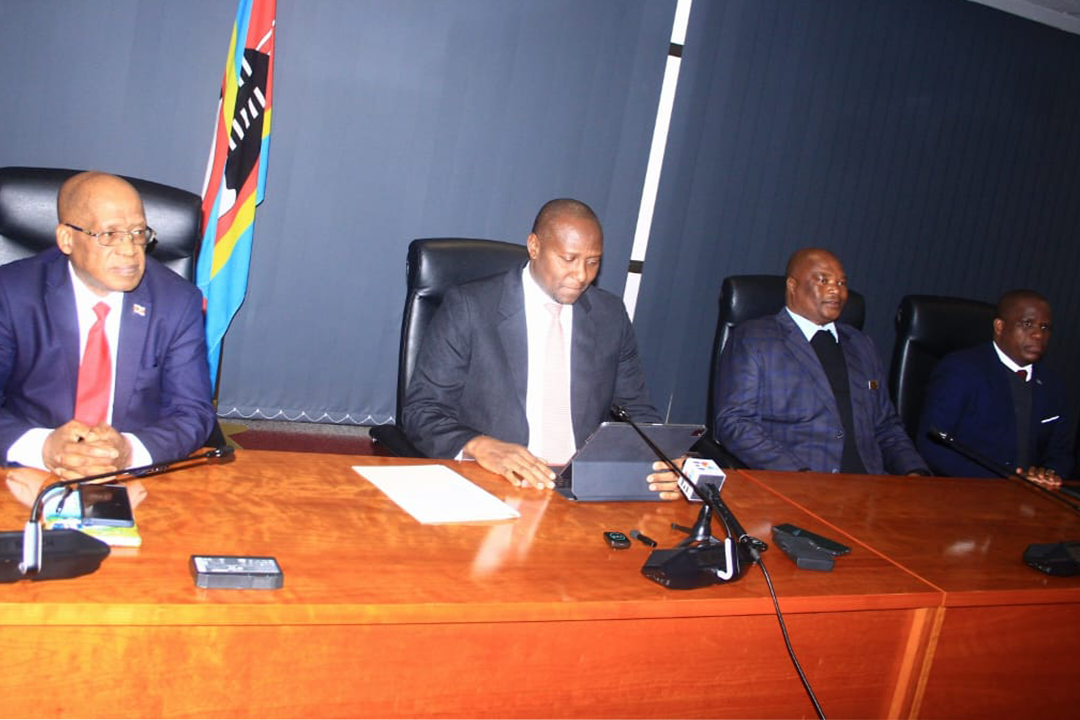
Presenting the Government Performance Report at Cabinet on Wednesday, Prime Minister Russell Mmiso Dlamini said the improvement demonstrated that Ministries had accelerated implementation during the financial year, while cautioning that greater urgency was necessary to meet the country’s 2029 development ambitions.
“This improvement demonstrates meaningful progress as Ministries accelerated implementation during the year,” the Prime Minister said.
“At the same time, it underscores the need for renewed urgency if we are to achieve the ambitious targets set under the Nkwe Programme of Action.”
The Economic Growth objective’s 50 per cent score places it above the national Government performance average of 48 per cent. It also means that economic transformation performed considerably better than Human Capital Development, which recorded the lowest score at 37 per cent.
The report attributes the 50 per cent economic growth performance to progress in several foundational interventions, particularly infrastructure aimed at supporting investment and industrial development.
Among the areas where Government performed strongly were the One-Stop Centre and factory shells, which the report identifies as important interventions supporting the business environment and investment facilitation.
The One-Stop Centre is intended to make it easier for businesses and investors to access Government services, while factory shells provide infrastructure that can facilitate industrial activity and employment creation.
However, the report makes it clear that the road to the 12 per cent GDP target remains challenging.
Performance was weaker in areas such as financial inclusion, integration of the informal sector and partnership models. According to the assessment, cross-cutting budget constraints affecting several Ministries were a major factor behind slower implementation in these areas.
This presents a significant challenge because achieving stronger economic growth requires not only infrastructure, but also broader participation in the economy, particularly by MSMEs and informal businesses.
The report’s findings suggest that while Government has established some of the foundations for economic expansion, further reforms and investment will be necessary to translate these interventions into higher economic output.
The Economic Growth objective is one of three areas that performed above the overall 48 per cent Government average. It was surpassed by Social Protection and Security at 56 per cent and Food Sovereignty and Sustainable Development at 55 per cent.
The 50 per cent economic score is therefore being viewed as evidence of moderate progress towards the country’s long-term transformation agenda, rather than confirmation that the 12 per cent target is already secured.
The Prime Minister acknowledged that Government continues to face several systemic obstacles that slow implementation. These include delayed budget releases, procurement bottlenecks, challenges in coordination between Ministries, legislative delays and dependence on external funding partners.
“These issues contributed significantly to slower implementation of several planned outputs across Ministries,” Dlamini said.
Government’s overall performance, however, improved steadily throughout the year, rising from 22 per cent in the first quarter before reaching 48 per cent for the full financial year.
The Prime Minister said the improvement provided important lessons for Government as it moves towards the 2029 development targets.
The Government has consequently accepted recommendations contained in the performance report and intends to introduce reforms aimed at accelerating implementation.
Among the measures are the acceleration of resolutions adopted during the 2026 Cabinet Retreat, prioritisation of high-impact Programme of Action targets and the ring-fencing of resources for strategic projects.
Government also intends to strengthen quarterly performance monitoring and inter-Ministerial coordination, while introducing consequence management to reward strong performance and address underperformance.
The report’s assessment of the six national objectives shows that progress remains uneven. Social Protection and Security recorded the highest performance at 56 per cent, followed closely by Food Sovereignty and Sustainable Development at 55 per cent. Economic Growth followed at 50 per cent, while Infrastructure and ICT recorded 48 per cent and National Security and Law Enforcement 43 per cent.
Human Capital Development, which includes education and health, came last at 37 per cent.
The Government’s economic performance therefore comes against a broader picture in which some sectors are moving faster than others.
The Prime Minister said Government would seek to replicate successful models across the public service while improving coordination and accountability.
“By scaling successful models, front-loading implementation, improving coordination and reinforcing accountability, Government is determined to deliver measurable improvements in service delivery and to realise the aspirations of the Programme of Action,” he said.
The report also highlights the importance of timely performance reporting. Only six Ministries submitted their annual performance reports within the prescribed timelines, while 16 submitted them after the deadline.
Government says delayed reporting makes it difficult to monitor implementation in real time and limits its ability to intervene early when programmes fall behind.
For the 12 per cent GDP ambition, the 50 per cent Economic Growth performance score provides a positive indication of progress, but also highlights the considerable work still required.
The Prime Minister said the lessons from the assessment would guide future planning, resource allocation and performance management.
“The findings of this report provide a clear roadmap for strengthening Government performance and ensuring that national development commitments translate into tangible benefits for the people of Eswatini,” he said.
#Eswatini #EconomicGrowth #12PercentGDP #GDP2029 #NkweProgrammeOfAction #GovernmentPerformance #EconomicTransformation #MSMEs #Investment #BusinessGrowth #EconomicDevelopment #EswatiniEconomy #Government #2029Targets #ServiceDelivery