


… Kingdom tables four more standards for re-rating in Rwanda
… High-level delegation pushes reforms to protect financial system
… Government strengthens fight against money laundering, terrorism financing
BY MBONGENI NDLELA
KIGALI, RWANDA— Eswatini has recorded a significant leap in strengthening its financial crime prevention systems, improving its compliance with international standards from just 14 to 28 out of 40, as the Kingdom intensifies reforms aimed at protecting the integrity and credibility of its financial system.

The progress, achieved following the country’s 2022 Mutual Evaluation, represents one of the clearest indications yet of the work being undertaken by Government, regulators, law enforcement agencies and financial institutions to address weaknesses previously identified in Eswatini’s anti-financial crime framework.
And the Kingdom is not stopping at 28.
During the ongoing Eastern and Southern Africa Anti-Money Laundering Group (ESAAMLG) meetings in Kigali, Rwanda, Eswatini has submitted a further four international standards for re-rating, potentially opening the door for the country to demonstrate additional progress made through legislative, regulatory and institutional reforms.
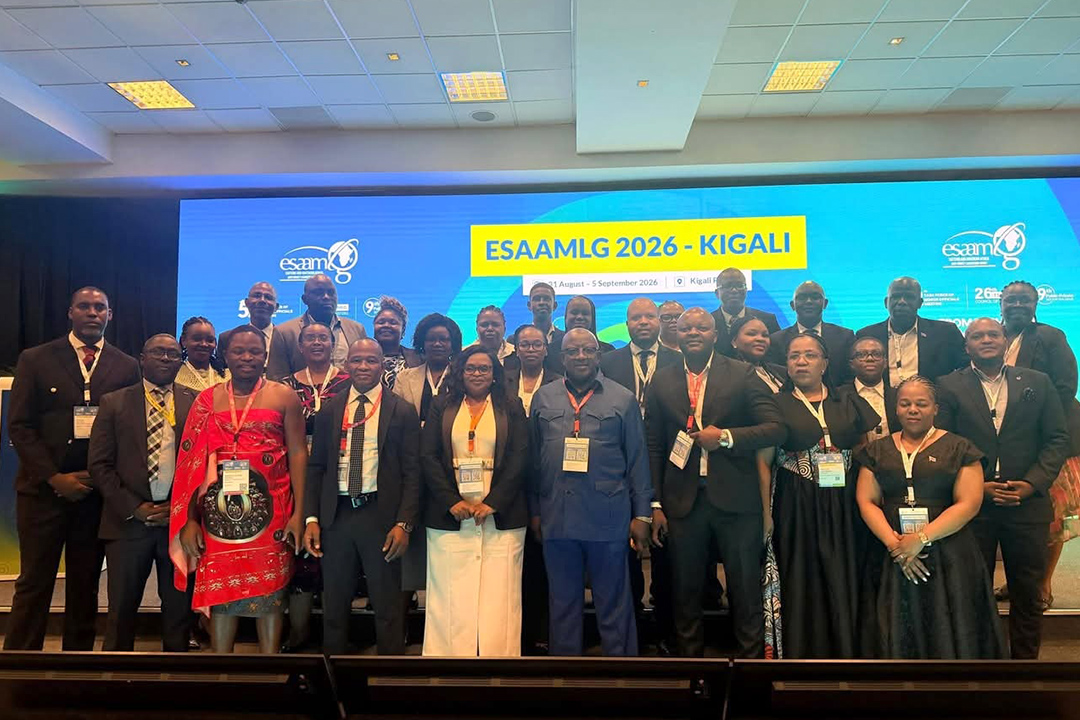
The development comes as a high-powered Eswatini delegation participates in the 52nd ESAAMLG Task Force of Senior Officials Plenary Meeting, part of regional meetings taking place in Kigali from August 31 to September 5, 2026.
The delegation is led by Ministry of Finance Principal Secretary Vusi Dlamini, alongside Attorney General Sifiso Khumalo and Eswatini Financial Intelligence Centre (EFIC) Director General Babhekile Matsebula.
They are joined by representatives of EFIC, senior Government officials, Members of Parliament serving on the Financial Portfolio Committee, Senators, officials from the Central Bank of Eswatini, the Financial Services Regulatory Authority (FSRA), law enforcement agencies and other institutions responsible for protecting the country’s financial system.
The broad delegation sends a strong message that combating financial crime is no longer viewed as the responsibility of one institution alone, but as a national undertaking requiring cooperation between lawmakers, regulators, investigators and the financial sector. The Ministry of Finance describes this as a whole-of-government approach to strengthening financial crime prevention and financial integrity.
FROM 14 TO 28 STANDARDS
At the heart of Eswatini’s presentation in Kigali is the progress achieved since the 2022 Mutual Evaluation.
Following that assessment, the country embarked on reforms aimed at closing gaps identified in its systems for Anti-Money Laundering (AML), Countering the Financing of Terrorism (CFT) and Countering Proliferation Financing (CPF).
According to the Ministry of Finance, the interventions have included amendments to legislation, improvements in regulation and strengthened institutional arrangements.
Those measures have resulted in the Kingdom improving its compliance from 14 to 28 of the 40 international standards against which countries are assessed.
The improvement is important because financial crime increasingly crosses national borders and can exploit weaknesses in banking systems, businesses, companies and other financial channels.
For Eswatini, strengthening its safeguards is therefore not simply about satisfying international assessments. It is fundamentally about protecting the country’s financial system from abuse and demonstrating that institutions are continuously improving their ability to identify, prevent and respond to illicit financial activity.
The latest review request gives the Kingdom an opportunity to present evidence of the changes made since its previous assessment.
Four additional standards have now been placed before the current plenary for possible re-rating, although discussions on Eswatini’s application remain ongoing within the ESAAMLG framework.
WHY THE KIGALI MEETING MATTERS
The Kigali meetings bring together policymakers, regulators, law enforcement agencies, financial intelligence units and other key stakeholders from across Eastern and Southern Africa.
Their common purpose is to strengthen regional cooperation in combating money laundering, terrorist financing and proliferation financing — crimes which can increasingly involve sophisticated networks and transactions extending across different jurisdictions.
For Eswatini, being at the table provides an opportunity not only to account for the reforms it has undertaken but also to learn from neighbouring countries and international partners.
ESAAMLG provides member states with a platform to share experiences, discuss emerging financial crime threats and strengthen cooperation in responding to increasingly complex risks.
Eswatini is using the meetings to interact with regional counterparts, share lessons from its own reform journey and learn from developments and best practices elsewhere in the AML, CFT and CPF environment.
WHAT THIS MEANS FOR EMASWATI
Although terms such as AML, CFT and CPF may sound highly technical, the broader objective is straightforward: protect the integrity of the country’s financial system.
A financial system that is better equipped to detect and prevent illegal transactions strengthens the institutions through which emaSwati save, transact and conduct business.
For legitimate businesses, the continued strengthening of financial safeguards also demonstrates that Eswatini is working to maintain financial systems that meet internationally recognised expectations.
The progress from 14 to 28 standards therefore represents more than an improved score. It reflects laws being reviewed, regulatory systems being strengthened and institutions being required to work more closely together.
It also means the country remains under a process of continuous improvement rather than treating the 2022 assessment as a once-off exercise.
ESWATINI MAKES ITS CASE
The current meetings therefore provide an important stage for Eswatini to make its case that reforms implemented since the previous assessment deserve recognition.
While the outcome of the latest four standards submitted for re-rating is still to be determined, the move itself demonstrates that the Kingdom believes sufficient additional progress has been made to warrant another review.
The Ministry of Finance says Eswatini’s participation reflects its continued commitment to strengthening its AML/CFT/CPF framework while safeguarding the integrity of its financial system.
As deliberations continue in Kigali, the delegation is expected to remain involved in both the review process and broader regional discussions, building on progress already achieved while strengthening the country’s response to financial crime.
From 14 compliant standards to 28, and with another four now under consideration, Eswatini’s message in Kigali is increasingly clear: the Kingdom intends to keep strengthening its financial defences, working with regional partners and closing the gaps that can expose financial systems to abuse.
(Courtesy Pic)