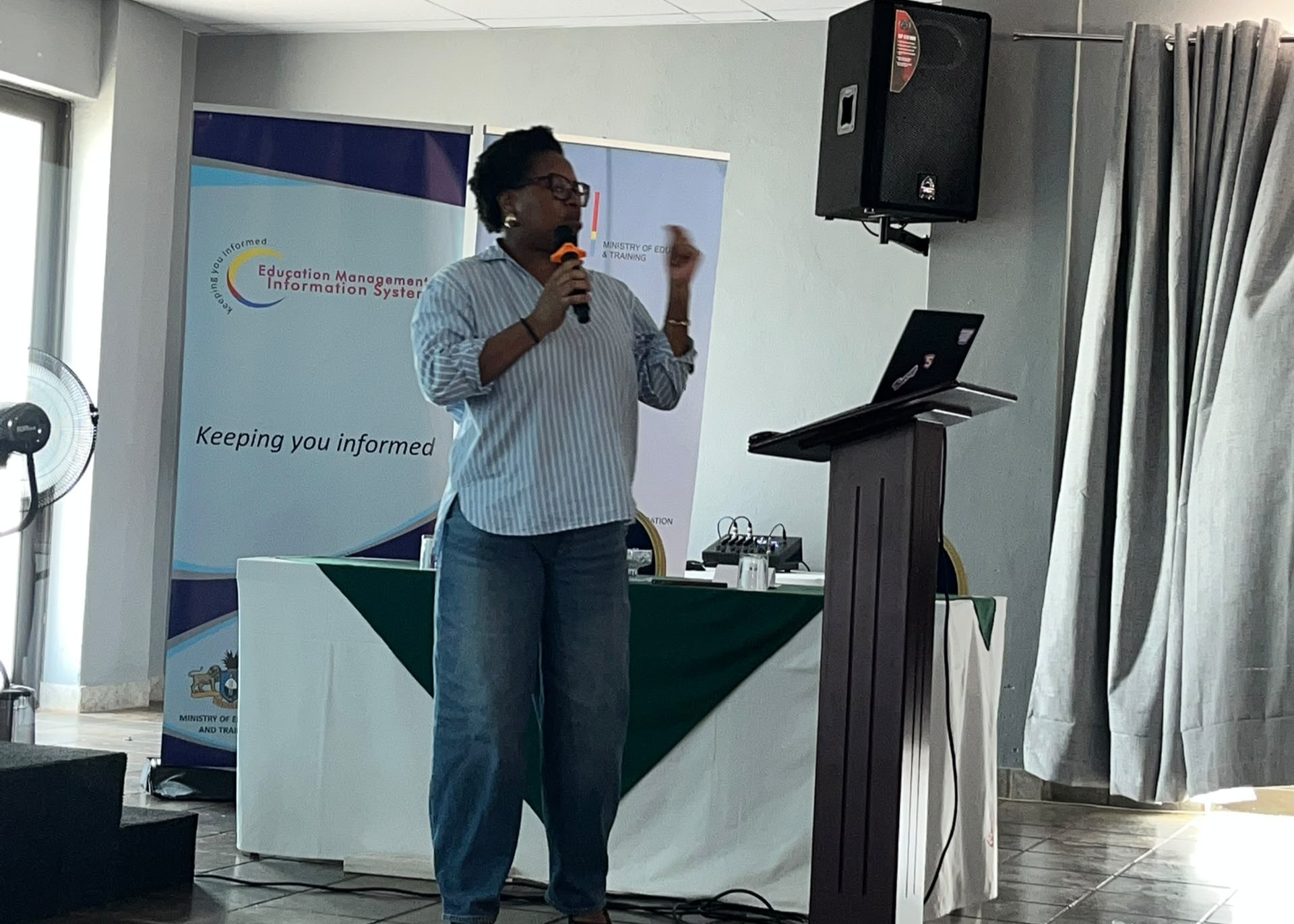




– Proposed reforms include faster EMIS reporting, improved teacher deployment data and a dashboard to help government officials make evidence-based decisions.
BY NELIWE NGUBANE
EZULWINI – Decisions on where to build classrooms, deploy teachers and direct education resources could become more evidence-driven under a proposed 15-month action plan aimed at strengthening Eswatini’s Education Management Information System (EMIS) and improving how government uses education data.
The plan, presented by consultant Nontobeko Tshabalala-Fleming during the Eswatini EMIS Data Use Workshop at Sibane Sami Hotel on Friday, 16 October 2026, outlines measures to address data gaps, improve information sharing and ensure that education statistics translate into practical decisions affecting schools and learners.
Titled the Data Use Action Brief: Strengthening the Production and Use of Education Data, October 2026–December 2027, the draft plan identifies six priority areas for improvement, including data quality, missing information, communication of findings, access and coordination, and staff capacity.

The proposed reforms are intended to help the Ministry of Education and Training and other stakeholders make better-informed decisions on teacher deployment, school infrastructure, learner support, curriculum implementation and technical and vocational education and training (TVET).
Tshabalala-Fleming’s presentation highlighted findings from eight working groups that recorded 22 priority decisions requiring better evidence over the next 12 to 24 months.
These decisions include planning new schools and classrooms, determining teacher requirements, improving inclusion and learner support, distributing school supplies according to enrolment, and strengthening curriculum and TVET planning.
The presentation noted that many of these decisions are currently informed by requests from schools, previous allocations and periodic reports rather than routine analysis of EMIS data.
Several barriers contribute to this challenge, including inconsistent data, missing information, delays in reporting, difficulties accessing records held by other departments, limited analytical skills and reports that do not adequately meet managers’ needs.
The proposed action brief seeks to address these weaknesses by improving how data is collected, validated, analysed, shared and communicated to decision-makers.
One of the proposed priorities is to make EMIS data more timely and reliable.
The plan recommends introducing validation rules and completeness checks into the termly EMIS reporting tool so that errors can be identified when information is entered, rather than discovered much later.
It also proposes an annual EMIS data calendar aligned with the budget cycle, teacher post declarations and school terms.
Training for school EMIS focal persons and regional officers is another proposed intervention, alongside connectivity support for schools that struggle to submit returns on time.
Quarterly data-quality checks comparing school registers with EMIS records are also proposed to strengthen confidence in the information used for planning.
The plan further recommends revising EMIS reporting instruments to capture information that is currently missing or insufficiently detailed.
This includes information on learners with special educational needs, orphans and vulnerable children (OVC), Life Skills Education teachers, learner transport and distance to school, teacher housing, water, furniture, Grade 0 and school feeding.
The revised instruments would first be piloted in schools across Eswatini’s four regions before being finalised.
A major focus of the proposed action plan is ensuring that education data answers specific questions about resource allocation and service delivery.
For teacher deployment, the plan proposes analysing the number of teacher posts required for 2027, including subject-specific needs and deputy headteacher posts for schools with high enrolment.
Such information could help the Ministry identify staffing shortages and determine where teachers are most urgently needed.
School mapping is another priority. The proposed analysis would consider the school-age population, distances learners travel to school and feeder-school patterns to guide decisions on new schools, classrooms, water tanks and furniture.
The plan also identifies the need to assess options for extending Free Primary Education to Grade 0, taking into account the availability of trained teachers and suitable facilities.
In addition, a school feeding and supplies requirement model based on enrolment is proposed to help align provision with the number of learners at each school.
These analyses are intended to support planning that responds more closely to conditions on the ground.
The proposed action brief also places emphasis on using data to identify learners who may require additional support.
It recommends analysing information on special educational needs, OVC and learners with disabilities by region and school. Guidance would also be developed to help teachers identify learners with special educational needs and report the information through EMIS.
For technical and vocational education and training, the plan proposes examining training provision, scholarship distribution and industry skills demand to strengthen the relationship between training opportunities and workforce needs.
Life Skills Education staffing data and a monitoring tool are also included among the proposed priorities.
The plan further calls for an evidence pack to support the implementation of the Competency-Based Curriculum, helping decision-makers access relevant information as they assess curriculum requirements and implementation needs.
Beyond collecting better information, Tshabalala-Fleming’s presentation highlighted the importance of ensuring that existing data can be accessed and understood by the people who need it.
The draft plan proposes an inter-ministerial data-sharing protocol to improve access to information held across government institutions.
It also recommends an EMIS dashboard for managers, regional offices and partners, supported by an annual statistical yearbook and a termly bulletin.
These products would be designed to make education information easier to access and use, while presenting findings in formats suited to different audiences.
A data-use technical working group, bringing together units that produce and use information and relevant partners, is proposed to meet quarterly to monitor implementation and resolve data requests.
The plan also calls for clearer communication of findings through concise messages, policy briefs and other products that help senior officials understand the implications of the evidence.
The proposed implementation period runs from October 2026 to December 2027 and is divided into three phases.
The first phase, from October to December 2026, would focus on establishing coordination structures, issuing the data calendar, introducing validation rules, revising EMIS instruments, estimating teacher posts for 2027 and beginning work on the curriculum evidence pack.
The second phase, from January to June 2027, would prioritise training, piloting revised reporting instruments, agreeing on a data-sharing protocol, linking teacher records and undertaking priority analyses. A six-month review is also planned for this period.
The final phase, from July to December 2027, would focus on releasing the dashboard, yearbook and bulletins, completing inclusion and TVET analyses, issuing policy briefs and holding an annual Education Data Use Forum. A 12-month review is also proposed.
To monitor progress, the plan recommends quarterly reporting against agreed outputs and indicators, using a simple red, amber and green status system. The action plan would be updated following each formal review.
The proposed arrangements are intended to ensure that responsibilities are clearly assigned and that progress can be assessed throughout implementation.
The Data Use Action Brief was presented as a draft for validation during the workshop, with the proposed measures intended to strengthen the production and use of education data across government.
The initiative builds on Eswatini’s existing EMIS, the EMIS Norms and Standards self-assessment and lessons from the 2024 GPE-KIX synthesis report on EMIS data systems and data use.
The workshop was convened by the Ministry of Education and Training in collaboration with the African Union Commission through AU-IPED, the GPE-KIX Africa 19 Hub and Life Skills Promoters.
If implemented, the proposed measures could help the Ministry move from relying heavily on periodic reports and historical allocations towards more routine analysis of evidence when making decisions.
Ultimately, the plan’s success will depend on the adoption of its recommendations, the commitment of responsible institutions and the ability to turn improved information into practical interventions for schools and learners.
#EswatiniPositiveNews #Education #EMIS #DataDrivenDecisions #EducationPlanning #AUIPED #GPEKIX #EducationForAll #Eswatini