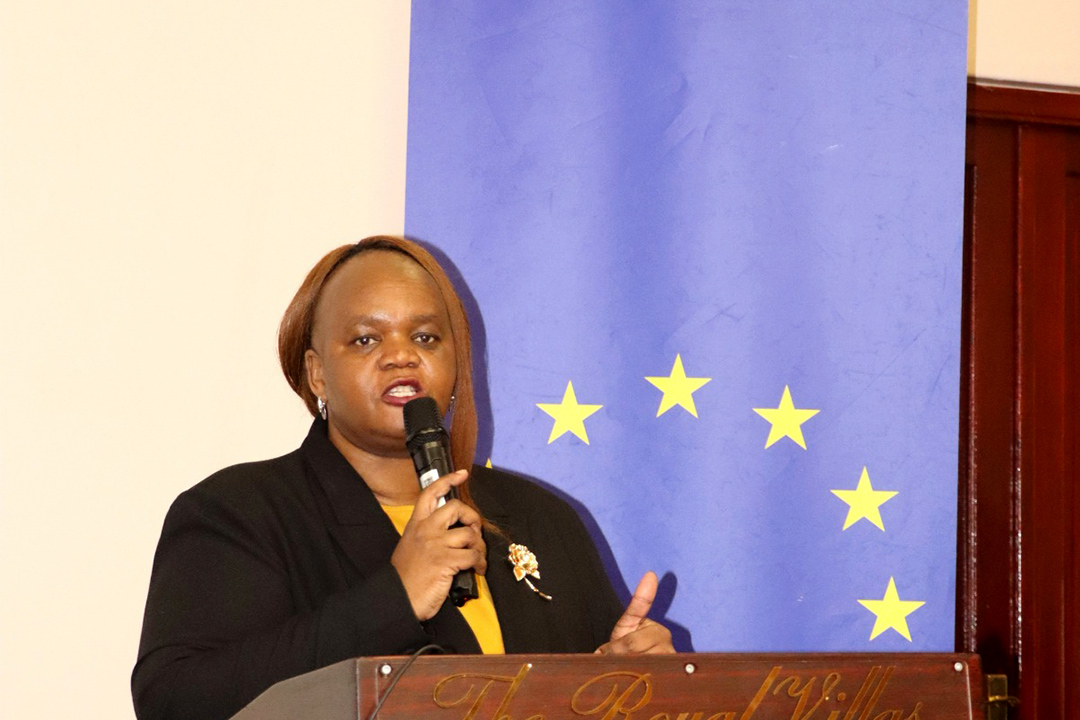



BY THEMBA ZWANE
MBABANE- The European Union (EU) and the International Trade Centre (ITC) are supporting Eswatini Government, through the International Trade Department (ITD) of the Ministry of Commerce, Industry and Trade, to develop a practical and implementable export roadmap.
The roadmap aims to strengthen the country’s export competitiveness, diversify markets, and help more businesses successfully enter and remain in international markets.
This support forms part of the interventions under the “Eswatini: Promoting growth through competitive alliances” programme funded by the EU and implemented by ITC in partnership with Eswatini Government.
With Eswatini’s previous National Export Strategy developed approximately 20 years ago, the current process focuses on creating a forward looking three year roadmap that builds on existing strategies while prioritizing realistic interventions aligned with national implementation capacity.

EU Programme Officer Bhekani Magongo said the support reflects the EU’s continued commitment to strengthening Eswatini’s private sector and enabling businesses to use international trade opportunities.
“For exports to contribute meaningfully to inclusive economic growth, businesses need more than access to markets; they need the capacity, information, standards, support systems and partnerships required to compete sustainably. Through our partnership with ITC and the Government of Eswatini, the EU is supporting the development of a roadmap that can translate existing opportunities into practical actions for businesses, particularly MSMEs, while promoting greater market diversification,” Magongo said.
Representing the Principal Secretary in the Ministry of Commerce, Industry and Trade at one of the consultative meetings held recently, Dr Celucolo Dludlu welcomed the technical assistance from ITC and the longstanding support provided by the EU.
“Government remains committed to expanding domestic and international trade through improved trade facilitation, stronger market access and enhanced export competitiveness,” Dludlu said, noting the ambition to see more Eswatini products competing internationally.
Preliminary analysis undertaken by ITC has identified strong export performance alongside structural vulnerabilities. ITC Consultant Claudia Manguila noted that Eswatini is a highly open economy, with trade representing 107% of GDP and exports reaching USD 2.4 billion in 2024.
However, exports remain highly concentrated. 62% of Eswatini’s exports go to South Africa, while 80% are destined for Africa overall. The analysis further indicates that 25% of exports come from a single beverage manufacturer, while the top 1% of exporting SMEs account for 76% of exports.
Manguila said this concentration strengthens the case for diversification while upgrading sectors already generating exports.
The assessment has also identified critical challenges across the export journey. These include limited and overly general market and buyer intelligence; difficulties navigating standards, regulatory requirements and trade agreement provisions; insufficient targeting of buyer opportunities towards export-ready firms; fragmented financial, payment, logistics and institutional support; and weak commercial follow-up after businesses enter new markets.
Export survival is another major concern. Analysis covering 2015 to 2024 indicates that only about 39% of new product-market relationships survive, pointing to weaknesses in continuity between identifying an opportunity, entering a market and sustaining sales. Limited awareness and utilization of existing trade agreements, including the EU-SADC Economic Partnership Agreement, were also highlighted.
“The problem is therefore not necessarily missing services because there are institutions and services. It is the absence of continuity from the opportunity to the sales,” Manguila said.
Director of the International Trade Department Lungile Dlamini said the roadmap will help Eswatini identify and prioritize sectors where the country has a competitive advantage, while strengthening a value-chain approach to export development.
“We partner together so that we can increase our exports as a country,” Dlamini said. She also encouraged businesses to make greater use of market-access arrangements, including the SADC-EU EPA, noting the importance of the EU as a reliable export market.
Business Federation of Eswatini (BUFE) President Thulisile Dladla stressed the need to broaden participation in exports and reduce dependence on large companies.
“We need to embark vigorously on programmes that will empower MSMEs,” she said. “They also need to understand that the export market has standards and requirements. We need to simplify these things to make sense to an ordinary Liswati who wants to explore the export market.”
Through the roadmap, the EU, ITC, Government and private-sector stakeholders aim to establish export priorities, strengthen coordination among export-support institutions and create a more connected pathway that helps Eswatini businesses move from export potential and market entry to sustainable international sales.
About the European Union Delegation to Eswatini
The EU Delegation to Eswatini is responsible for managing diplomatic relations between the EU and the Kingdom of Eswatini. These relations cover political relations, development cooperation, economic and trade relations as well as other areas of mutual interest between the two partners. The central objective of this partnership is to reduce and ultimately eradicate poverty through sustainable development, the progressive integration of Eswatini into the world economy, and the promotion of the rule of law, democracy, and human rights.
About ITC
The International Trade Centre is the joint agency of the World Trade Organization and the United Nations. ITC assists small and medium-sized enterprises in developing and transitioning economies to become more competitive in global markets, thereby contributing to sustainable and inclusive economic development within the frameworks of the Aid-for-Trade agenda and the United Nations’ Sustainable Development Goals (SDGs).
About the Programme
The ITC-Alliances for Action programme ‘Eswatini: Promoting growth through competitive alliances’, funded by the EU, supports job creation for small farmers, entrepreneurs, and artisans. Eswatini offers the global market unique organic produce, artisan roasted coffee, handmade cultural creations, and gourmet condiment lines.
ITC works closely with smallholder farmers, agro-processors, and artisans in Eswatini to support them in ways that are sustainable and benefit both people and the planet. In this way, ITC fosters and preserves cultural heritage, and draws on artisan skills and concepts of green growth.
Alliances for Action is an ITC initiative that seeks to transform food systems through producer partnerships that cultivate ethical, climate-smart, sustainable agricultural value chains.
#ICT #EU #Eswatini #Exports #Government #RoadMap
(Courtesy Pic)