


BY SIBUSISEKILE NDLANGAMANDLA
MANZINI – For young Emaswati with farming ambitions but limited access to capital, a zero-interest loan starting from E10 000 could be the difference between a business idea remaining on paper and becoming a working agricultural enterprise.
Through the Simama Project, emerging farmers are being offered access to interest-free agricultural financing coupled with practical business training aimed at helping them use borrowed money responsibly and build sustainable enterprises.
The project, implemented in partnership with the Eswatini National Agricultural Union (ESNAU), goes beyond simply placing money in the hands of farmers. Participants are taken through the loan application process, preparation of business plans and proposals, financial management, record-keeping and repayment planning.
Simama Project Director Acorn Mndzebele said the initiative was designed to ensure that farmers understand that access to finance also comes with responsibility.

The model allows farmers who manage their loans properly and repay on time to qualify for additional financing, creating room for gradual expansion rather than one-off support.
One young farmer already demonstrating what that approach can achieve is 26-year-old Neliswa Fakudze of Mankayane.
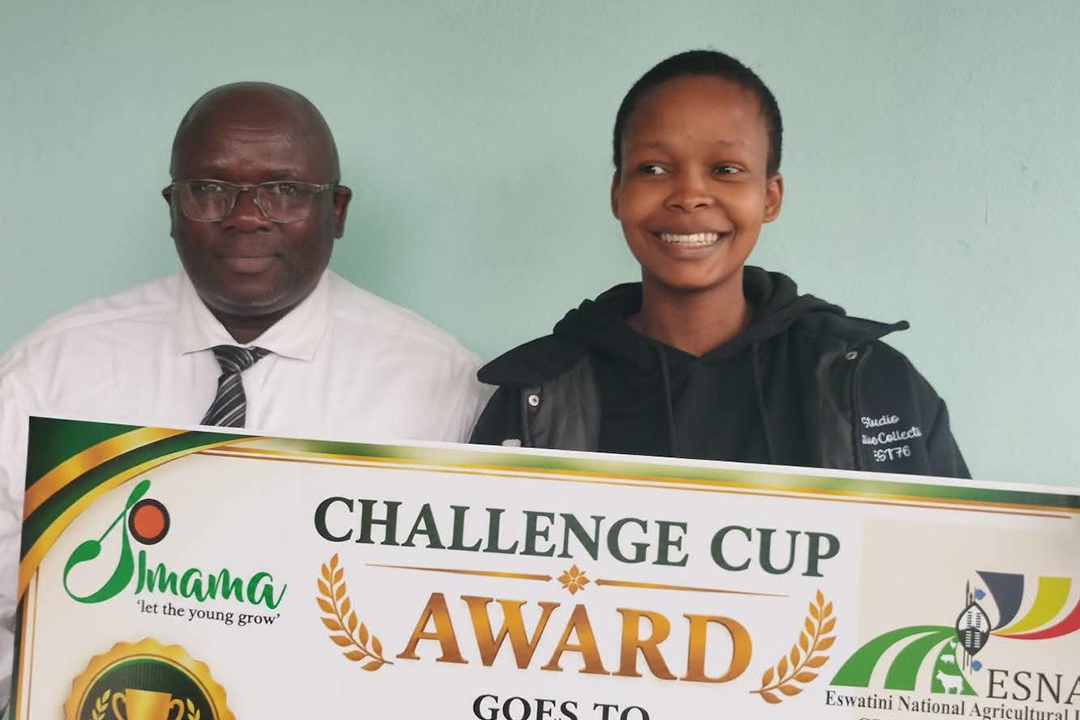
Fakudze was awarded the first Simama Project Challenge Cup after being recognised for the way she managed her farming enterprise and honoured her loan repayment obligations.
Her journey began on 23 March 2024 when she bought nine piglets at E650 each. What started as a small piggery has since expanded into breeding, while she also operates a broiler business at Mkhondvo.
The road, however, has not been without setbacks. High feed and transport costs have placed pressure on the business, while some customers have delayed payments. Instead of abandoning the venture, Fakudze has continued keeping records, monitoring her finances and reinvesting in the business.
That discipline has helped her qualify for further financing as she looks beyond piggery and poultry.
Her next ambition is to enter animal-feed production and eventually establish her own feedlot, a progression that illustrates how a small farming operation can develop into a broader agribusiness when growth is carefully managed.
Fakudze has encouraged other aspiring young farmers not to wait until they have large amounts of money before starting.
Her advice is to begin with what they can manage, keep proper records, continue learning and reinvest earnings into the business.
That message sits at the centre of the Simama initiative: finance alone does not guarantee success.
A farmer seeking funding needs a clear production plan, proper records, an identified market and a realistic repayment strategy. The programme is therefore seeking to develop not only farmers who can produce, but farmers who can manage agriculture as a business.
ESNAU Officer Phumzile Manyatsi said the partnership was helping create opportunities for young people while contributing towards a stronger future for youth participation in agriculture.
Importantly, financing under the Simama Project is not restricted to ESNAU members. Other farmers who meet the qualifying requirements may also seek assistance.
For young people such as Fakudze, the opportunity shows that agriculture can begin modestly, with a few animals, disciplined record-keeping and a workable plan, before growing into something much larger.
And for emerging farmers struggling to secure conventional finance, the combination of zero-interest loans and business training offers another possible route into commercial agriculture.