


BY MBONGENI NDLELA
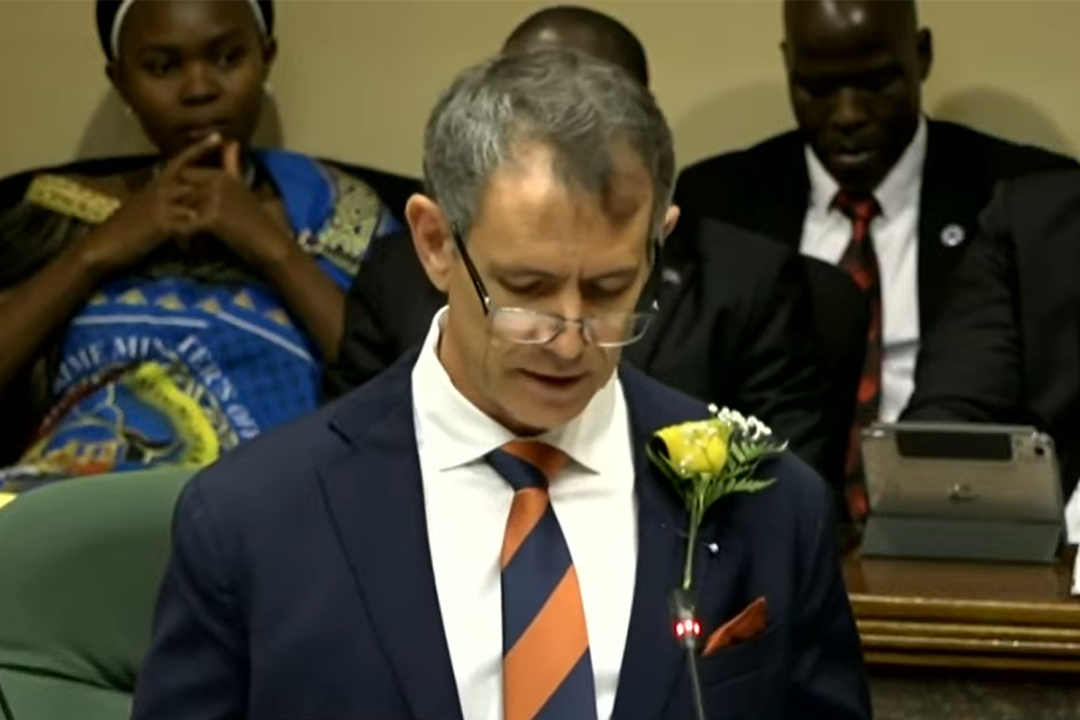
LOBAMBA – Minister of Finance Neal Rijkenberg delivered a bold and forward-looking 2026–2027 National Budget Speech, outlining a transformative fiscal plan anchored on the principle of agape love, a call to action rooted in discipline, accountability and economic acceleration.
Drawing a vivid picture of a rapidly shifting global landscape marked by geopolitical tensions, fragile supply chains and rising protectionism, the Minister made it clear that Eswatini will not retreat in uncertainty but advance with courage and clarity.
“A budget is more than numbers; it is a moral contract,” the Minister declared, positioning the financial plan as a direct response to His Majesty King Mswati III’s call for unity, integrity, improved service delivery and youth empowerment.
From Stability to Acceleration
After several years focused on stabilising public finances, strengthening reserves, improving debt management and restoring investor confidence, the 2026 budget marks a decisive transition. This is a pro-growth, pro-discipline and pro-investment budget.

Government is significantly increasing capital expenditure to accelerate infrastructure expansion, energy security, digital transformation and industrial growth. These investments are deliberate foundations for national productivity and long-term prosperity. Growth, however, will remain anchored in fiscal prudence to protect future generations from reckless debt.
Major Institutional Reforms Strengthen Accountability
A key highlight is the successful implementation of the Integrated Financial Management System (IFMS), OMSEBE. Ministries and departments are now operating under a fully integrated digital platform for planning and budgeting, enabling programme-based budgeting, real-time expenditure monitoring and enhanced transparency.
International Conference Centre to Boost Economic Diversification
The International Conference Centre will officially open on April 25, 2026. The facility is expected to position Eswatini as a premium regional destination for conferences, trade expos and global events, strengthening economic diversification.
Health Sector Reform: Medicines Supply Overhaul
Government has passed legislation transforming the Central Medical Stores into a standalone statutory entity. The reform will modernise procurement, storage and distribution systems, improve forecasting accuracy and eliminate medicine stock-outs.
Revenue Integrity Without Raising Taxes
Through customs reform, the declaration threshold at borders has been raised to E10 000. Early results show improved compliance and stronger customs monitoring, widening the tax base without increasing tax rates.
Salary Review Enhances Public Service Morale
Government implemented Scenario 3 of the comprehensive salary review following consultations under the Joint Negotiations Forum. The reform addressed long-standing disparities while maintaining fiscal sustainability.
Energy Independence Gains Momentum
Recently signed power purchase and grid agreements include solar projects, a 40-megawatt biomass facility and the Lower Makapelusa hydropower plant. Notices of intent have also been issued for up to 1,000 megawatts to independent power producers, strengthening renewable energy independence.
Strong Economic Growth Trajectory
Real GDP growth moderated to 3% in 2024 but rebounded strongly in 2025 to an estimated 5.6%, driven by infrastructure expansion and private investment. Growth is projected at 5.2% in 2026, supported by major infrastructure projects and sustained private sector investment. Inflation remains contained at an average of 3.2% in 2025.
A Budget Rooted in Action
While acknowledging challenges such as youth unemployment and climate vulnerability, the Minister emphasised that the 2026–2027 National Budget is a declaration of intent. Anchored in discipline, institutional reform and accelerated investment, it charts a confident course toward economic transformation and sustainable growth.