


BY MBONO MDLULI
KWALUSENI – The University of Eswatini (UNESWA) has intensified its efforts to curb gender-based violence (GBV) through strengthened campus security, expanded prevention programmes and closer collaboration with national and international partners, as it seeks to ensure safer learning environments for students and staff.
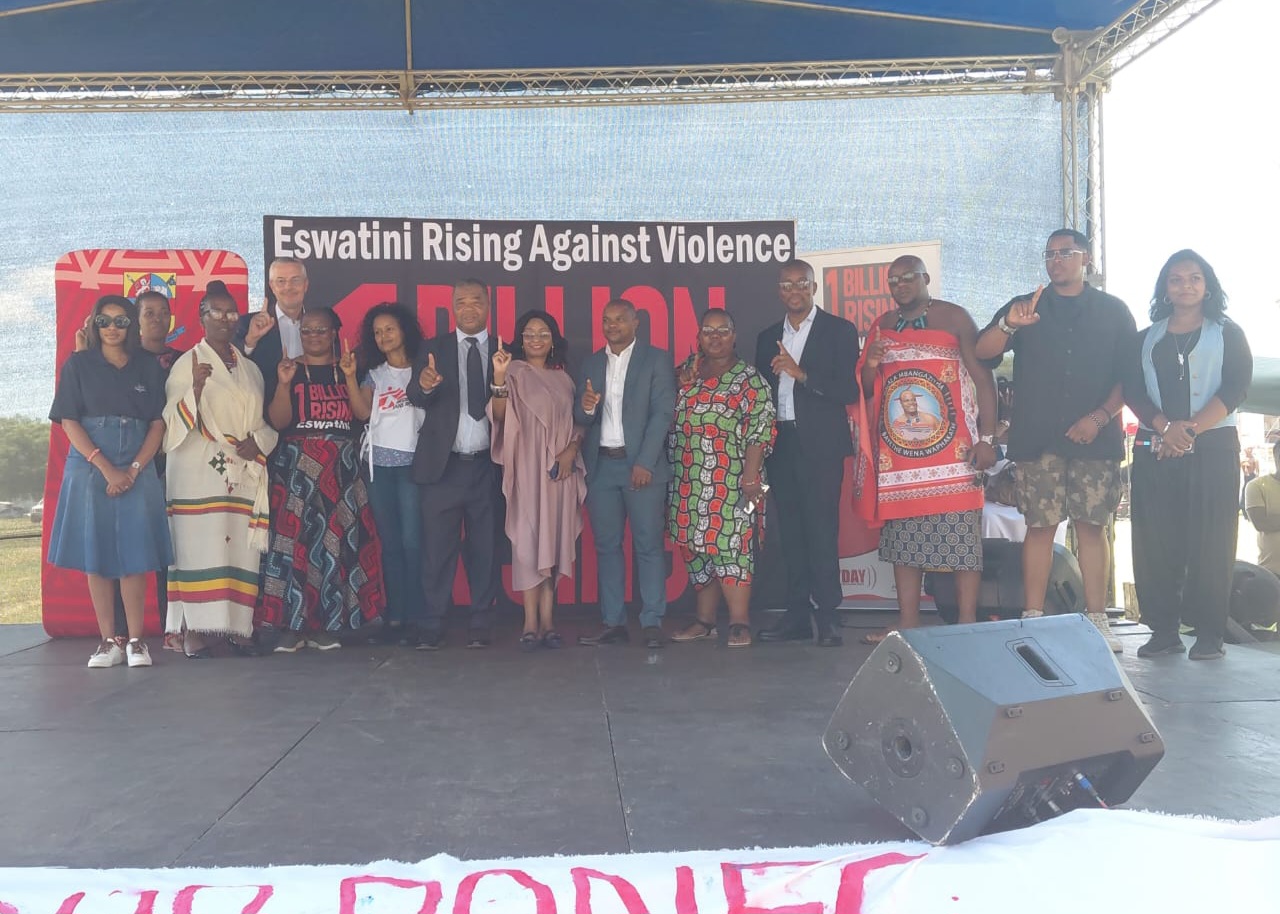
This commitment was outlined by UNESWA Vice-Chancellor Professor Justice Thwala on Saturday, 31 January 2026, during the One Billion Rising Eswatini Festival on Curbing GBV, held at the university’s Kwaluseni Campus under the theme “Rising for Our Bodies, Our Earth, and Our Future.”
Despite extreme heat, with temperatures approaching 30 degrees Celsius, more than 500 people attended the festival, demonstrating collective resolve to confront GBV. The event was organised by One Billion Rising Eswatini in partnership with UNESWA and brought together government officials, diplomats, development partners, civil society organisations, artists, students and community leaders.
Professor Thwala told the gathering that GBV poses a serious threat not only to individual safety but also to education outcomes and national development.

“Universities are not just places of learning,” he said. “They are training grounds for future leaders, parents, professionals and policymakers. If we change how young people understand consent, power and respect today, we change Eswatini tomorrow.”
He said UNESWA had embarked on a comprehensive strategy combining physical security upgrades, education and awareness, psychosocial support, and institutional reform. Planned and ongoing measures include improved perimeter fencing, enhanced lighting, controlled access points, trained response units, and proposals for biometric access systems and surveillance cameras to prevent unauthorised entry into student spaces.
Professor Thwala appealed to government, development partners and the private sector to support the university’s efforts, stressing that student safety must remain a national priority.
“No student should be attacked. No survivor should suffer because systems failed. No family should bury a child because violence went unchecked,” he said.
He explained that these initiatives are embedded within a transformation framework approved by the University Council, informed by the university’s Strategic Plan and a Cabinet-approved Task Team report. The Cabinet Implementation Task Team will provide advisory oversight to ensure reforms are implemented within existing governance and legal frameworks.
The festival was attended by senior representatives from key institutions. The Deputy Prime Minister’s Office (DPMO) was represented by Thandwa Dlamini, while the United Nations Population Fund (UNFPA) was represented by Head of Office Margaret Thwala-Tembe. The European Union in Eswatini was represented by Ambassador Karsten Mecklenberg, and Kwaluseni MP Sifiso Shongwe attended as the area legislator. Labour and civil society organisations were also present, including the Swaziland National Association of Teachers (SNAT).
Addressing the gathering, One Billion Rising Africa Coordinator Colani Hlatjwako expressed appreciation to all partners and supporters who contributed to the success of the festival. She said the fight against GBV required collective action across all sectors of society.
“We are grateful to all our partners for standing with us,” Hlatjwako said. “I appeal to leaders and policymakers to ensure that all people resident in Eswatini and elsewhere are protected, regardless of who they are or their status in society.”
Hlatjwako emphasised that protecting people’s bodies was inseparable from protecting the future of humanity. “If people’s bodies are not protected, the earth itself is in danger of not being protected,” she said. “That puts the future of humanity at risk.”
National evidence shared at the event underscored the urgency of the issue. Studies conducted by the DPMO in collaboration with UNESWA, supported by UNDP and other UN agencies, indicate that one in three women in Eswatini experiences sexual violence before the age of 18, while nearly half experience sexual violence in their lifetime. Young people aged 13 to 24 face disproportionately high risks.
Professor Thwala acknowledged that UNESWA has not been spared from GBV incidents. He cited past cases, including a highly traumatic incident in which a female student was brutally attacked by her intimate partner on campus. Although the student survived, the incident exposed serious gaps in prevention and security preparedness.
In another case, three female students were sexually violated after a social event when intruders accessed campus spaces through unsecured entry points.
“These incidents are not mentioned to sensationalise pain,” Professor Thwala said. “They are named to break silence, accept responsibility and demand action. They should never have happened, and they must never happen again.”
Research conducted at UNESWA and other local tertiary institutions shows that approximately 60 per cent of female students report experiencing attempted or completed sexual assault in their lifetime, while nearly 38 per cent experience sexual violence within a single year. Over 90 per cent of perpetrators are known to survivors, often as partners, friends or acquaintances.
In September 2025, UNESWA and One Billion Rising signed a Memorandum of Understanding, committing to sustained collaboration in GBV prevention, youth mobilisation, research, advocacy and the creation of safer campuses. Since then, tangible outcomes have included the rollout of Community Circles, peer advocacy initiatives and the hosting of the 2026 festival.
Speaking at the event, Kwaluseni MP Sifiso Shongwe thanked One Billion Rising Eswatini and UNESWA for hosting the festival and expressed gratitude to diplomats, officials and development partners for their support.
Shongwe noted that Kwaluseni is one of the most densely populated constituencies in Eswatini, with national influence due to the presence of major industries and tertiary institutions.
“People come from all corners of the country to work and to study in Kwaluseni,” he said. “What happens here affects the whole nation.”
He pleaded for intensified efforts to curb GBV within the constituency, adding that as a Member of Parliament, he would continue advocating for better working and learning conditions in Parliament and beyond.
“I will continue to support initiatives that benefit the people of Kwaluseni and Eswatini at large so that gender-based violence is reduced,” Shongwe said. He further urged One Billion Rising, UNESWA and partners to host similar events regularly in Kwaluseni to ensure that the message against GBV is continuously reinforced nationwide.
The festival concluded with renewed calls for collective action, with speakers emphasising that silence is no longer an option in the face of rising GBV. Participants reaffirmed their commitment to building campuses and communities where dignity, safety and respect are protected for present and future generations.